
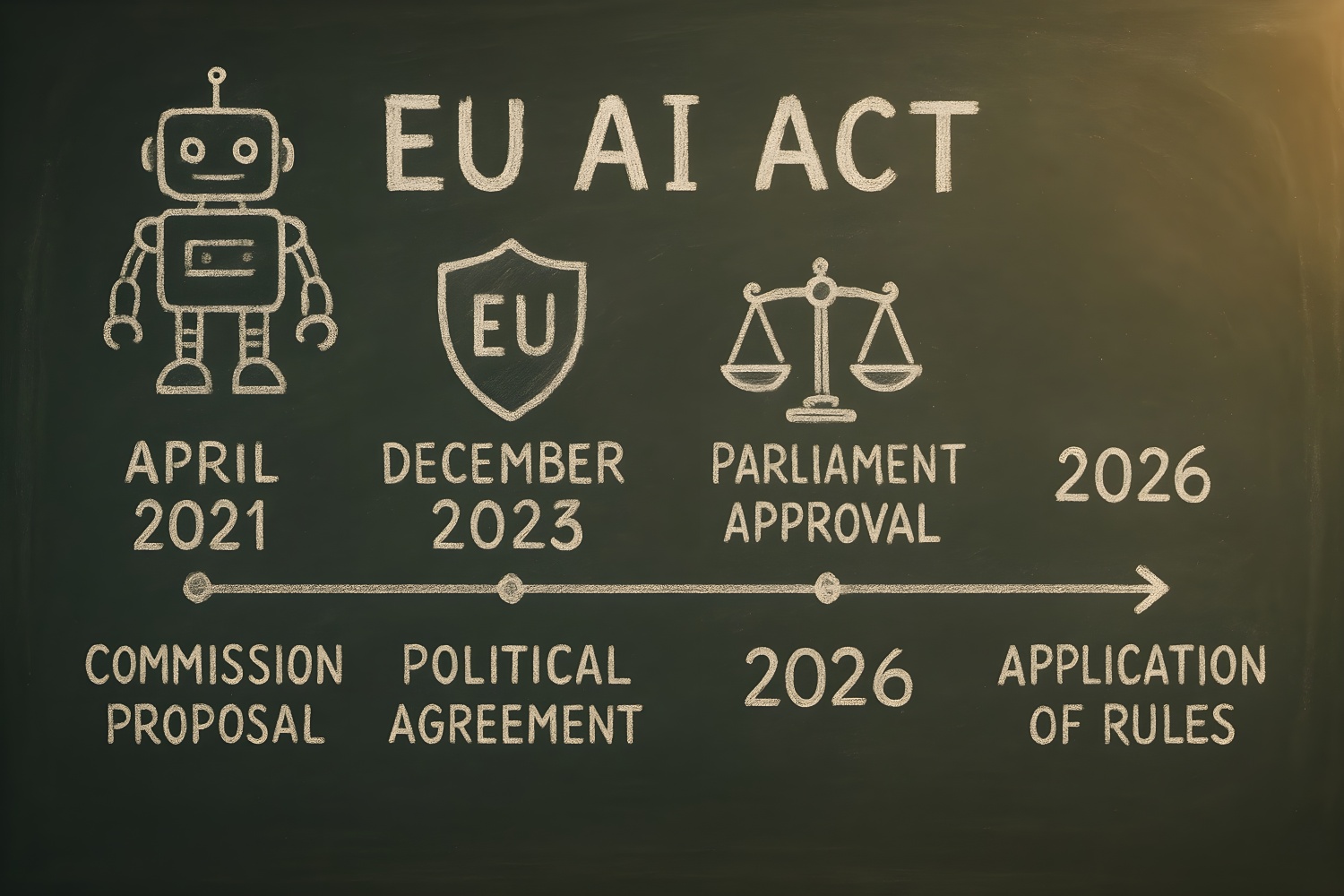
The EU AI Act is no longer a future regulation businesses can ignore. With several rollout phases already underway, companies that use AI must understand the rules. They must also know when each rule applies. Major obligations are due in 2026 and 2027.
For many organizations, the biggest challenge is not understanding the law itself — it is understanding the timeline.
In this guide, we explain the key EU AI Act enforcement date. We break down each major compliance milestone. We also outline what businesses should do now to prepare.
The EU AI Act entered into force in August 2024 and applies gradually through 2027. (AI Act Service Desk)
What Is the EU AI Act?
The EU AI Act is the European Union’s comprehensive regulation for artificial intelligence. It introduces a risk-based framework that classifies AI systems into four categories:
- AI systems that are not allowed
- High-risk
- Limited risk
- Minimal risk
The stricter the risk level, the stricter the compliance obligations.
The regulation applies to EU companies.
It also applies to non-EU companies.
This is true if they use AI systems that affect people in the EU.
Like GDPR, the EU AI Act is expected to influence AI laws and compliance standards around the world.
EU AI Act Enforcement Date: Complete Timeline
Understanding the EU AI Act enforcement date structure is essential for compliance planning. Unlike GDPR, the AI Act applies gradually through multiple phases.
August 2024 — Entry Into Force
The EU AI Act officially entered into force on 1 August 2024.
This marked the beginning of the implementation timeline, although most compliance requirements did not apply immediately. (AI Act Service Desk)
February 2025 — First EU AI Act Deadline
The first major EU AI Act deadline arrived on 2 February 2025.
At this stage:
- Prohibited AI practices became banned
- AI literacy obligations started applying
This includes systems involving:
- Social scoring
- AI systems that manipulate people
- Exploitation of vulnerable groups
- Certain uses of biometric data to classify people
Organizations also became responsible for ensuring employees using AI systems possess sufficient AI literacy and awareness. (AI Act Service Desk)
August 2025 — GPAI Rules Begin
On 2 August 2025, obligations for General-Purpose AI (GPAI) models started applying.
This phase mainly impacts providers of large AI foundation models and generative AI systems.
The EU AI Act requirements at this stage include:
- Transparency obligations
- Copyright compliance
- Technical documentation
- Governance measures
- Risk management processes
Businesses deploying generative AI internally should already be assessing governance and vendor risk exposure. (AI Act Service Desk)
August 2026 — The Main EU AI Act Enforcement Date
For most businesses, the critical EU AI Act enforcement date is 2 August 2026.
This is when the majority of the regulation becomes applicable and formal enforcement begins. (AI Act Service Desk)
Key obligations include:
- Transparency requirements
- Enforcement mechanisms
- Governance obligations
- Documentation requirements
- Human oversight measures
Most importantly, this phase introduces extensive obligations tied to high-risk AI systems.
Examples of high-risk AI systems include:
- Recruitment and HR tools
- Credit scoring systems
- Healthcare AI
- Educational assessment tools
- Critical infrastructure systems
Organizations deploying these systems may need:
- Risk management frameworks
- Technical documentation
- Bias monitoring
- Audit logs
- Human oversight procedures
- Incident reporting systems
For many organizations, EU AI Act 2026 preparation will become one of the largest governance projects since GDPR implementation.
EU AI Act High-Risk Systems Compliance Deadline
One of the fastest-growing compliance searches today is the EU AI Act high-risk systems compliance deadline.
Originally, the EU planned to apply many high-risk AI obligations fully in August 2026. However, recent EU AI Act news suggests that some deadlines could change.
These changes are part of proposed amendments. The amendments are linked to the Digital Omnibus package.
Current discussions suggest:
- Some standalone high-risk AI obligations may move to December 2027
- Product-related AI obligations could extend into 2028
However, businesses should not treat possible delays as a reason to postpone compliance preparation.
Even if implementation timelines shift slightly, organizations still need:
- AI inventories
- Governance frameworks
- Documentation processes
- Vendor oversight
- Risk assessments
Building these operational foundations takes time.
Latest EU AI Act News and Updates
Recent EU AI Act news has focused heavily on implementation delays, industry pressure, and enforcement readiness.
The European Commission has proposed adjustments intended to:
- Simplify compliance for businesses
- Reduce administrative burdens
- Delay certain high-risk AI obligations until harmonized standards are available
Despite these discussions, the direction of the regulation remains unchanged.
The EU AI Act is still expected to become the world’s most influential AI governance framework, much like GDPR reshaped global privacy compliance.
Businesses should therefore focus on long-term AI governance rather than short-term deadline changes.
EU AI Act Requirements Businesses Should Prepare For
Even organizations that are not building AI systems directly may still fall within scope as deployers or operators.
The EU AI Act requirements vary depending on whether your organization acts as:
- Provider
- Deployer
- Importer
- Distributor
Key compliance areas include:
AI Inventory and Risk Classification
Organizations should identify:
- Which AI systems they use
- Which departments rely on AI
- Whether systems qualify as high-risk
Without proper AI inventory mapping, compliance becomes extremely difficult.
Documentation and Governance
The regulation strongly emphasizes accountability and governance.
Businesses may require:
- AI governance policies
- Risk assessments
- Vendor management procedures
- Human oversight controls
- Documentation frameworks
This is especially important for organizations using third-party AI vendors.
Transparency Obligations
Certain AI systems must disclose when users interact with AI-generated content.
This includes:
- Chatbots
- AI-generated media
- Recommendation systems
- Deepfakes
Transparency obligations are expected to become a major enforcement focus during EU AI Act 2026 implementation. (AI Act Service Desk)
Why Businesses Should Start Preparing Now
Many companies assume they still have plenty of time before enforcement begins.
In reality, AI governance implementation can take months — especially for organizations using:
- HR AI tools
- Customer support AI
- Marketing automation
- AI agents
- Internal generative AI systems
Recent industry discussions also show many organizations underestimate how broadly the regulation applies to deployers, not just AI vendors.
The earlier organizations begin mapping their AI ecosystem, the easier compliance becomes.
Why the EU AI Act Matters for Businesses
The EU AI Act is more than just another technology regulation. It changes how businesses develop, buy, and use AI systems across everyday operations.
Companies that already manage GDPR, cybersecurity, and vendor risks will also need processes for managing AI systems.
This is especially important for organizations using AI in:
- Recruitment
- Customer service
- Marketing automation
- Fraud detection
- Employee monitoring
- Decision-making systems
Even businesses that do not build AI internally may still have compliance responsibilities when using third-party AI tools.
How Sovy Can Help
Preparing for the EU AI Act requires more than legal interpretation. Businesses need scalable operational governance processes.
Sovy Data Privacy Essentials helps organizations simplify privacy and compliance management through practical workflows, governance support, and documentation processes.
For businesses navigating AI governance alongside GDPR and cybersecurity obligations, building a strong compliance foundation early can significantly reduce future legal and operational risk.
FAQs
What is the main EU AI Act enforcement date?
The main EU AI Act enforcement date is 2 August 2026. This is when most of the rules and compliance requirements officially start applying. (AI Act Service Desk)
When does the EU AI Act fully apply?
The EU AI Act officially started in August 2024, but the rules will roll out gradually through 2027. Some requirements for high-risk AI products may extend into 2028.
What are high-risk AI systems under the EU AI Act?
High-risk AI systems include AI used in:
- Employment
- Healthcare
- Education
- Financial services
- Critical infrastructure
- Law enforcement
These systems face stricter governance and compliance requirements.
Is the EU AI Act being delayed?
The EU may delay some high-risk AI rules, but it still plans to introduce many important requirements on time.
Businesses should continue preparing based on the current implementation roadmap.
What penalties exist under the EU AI Act?
Organizations may face significant fines depending on the severity of violations, including percentages of global annual turnover for prohibited practices and serious compliance failures.
